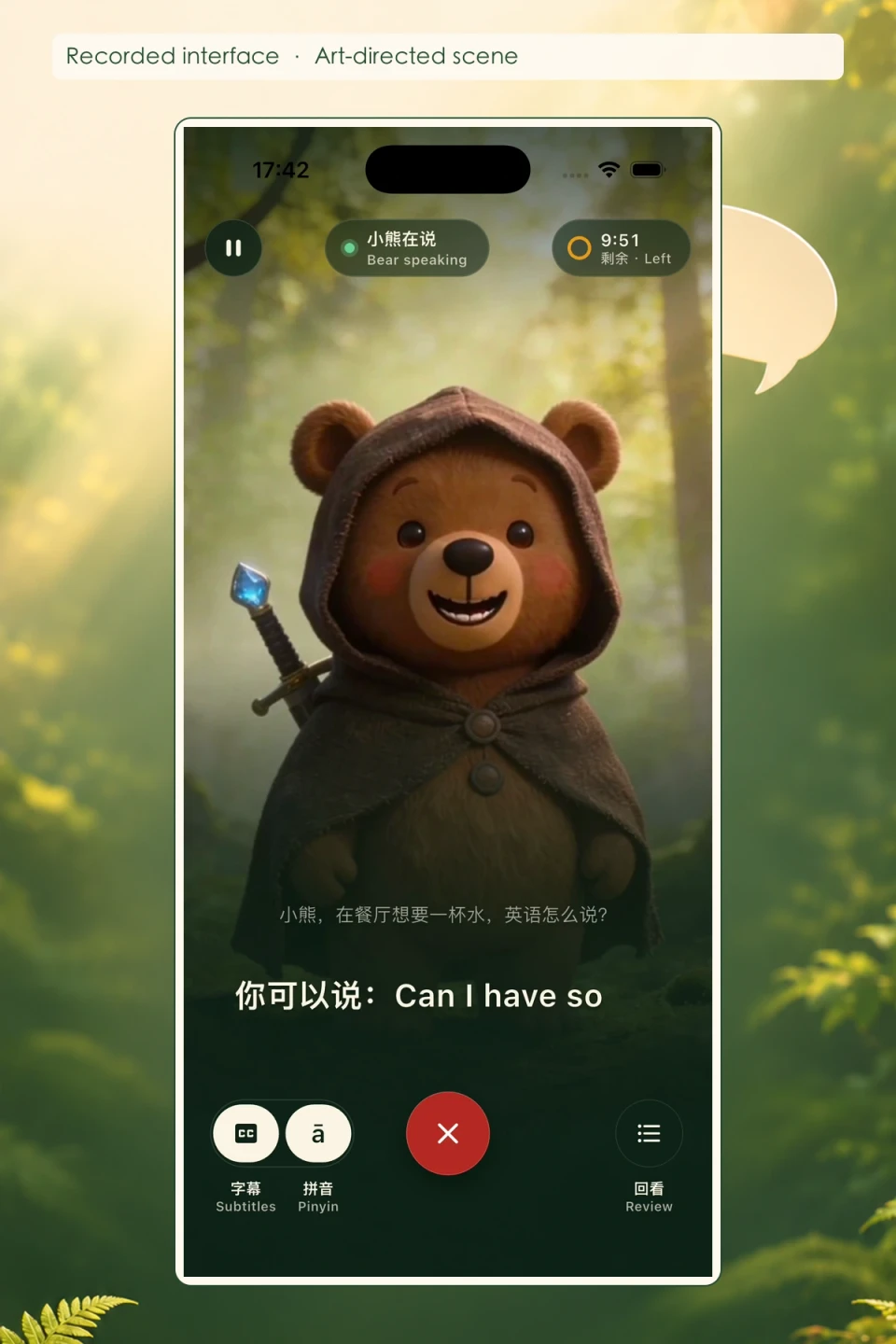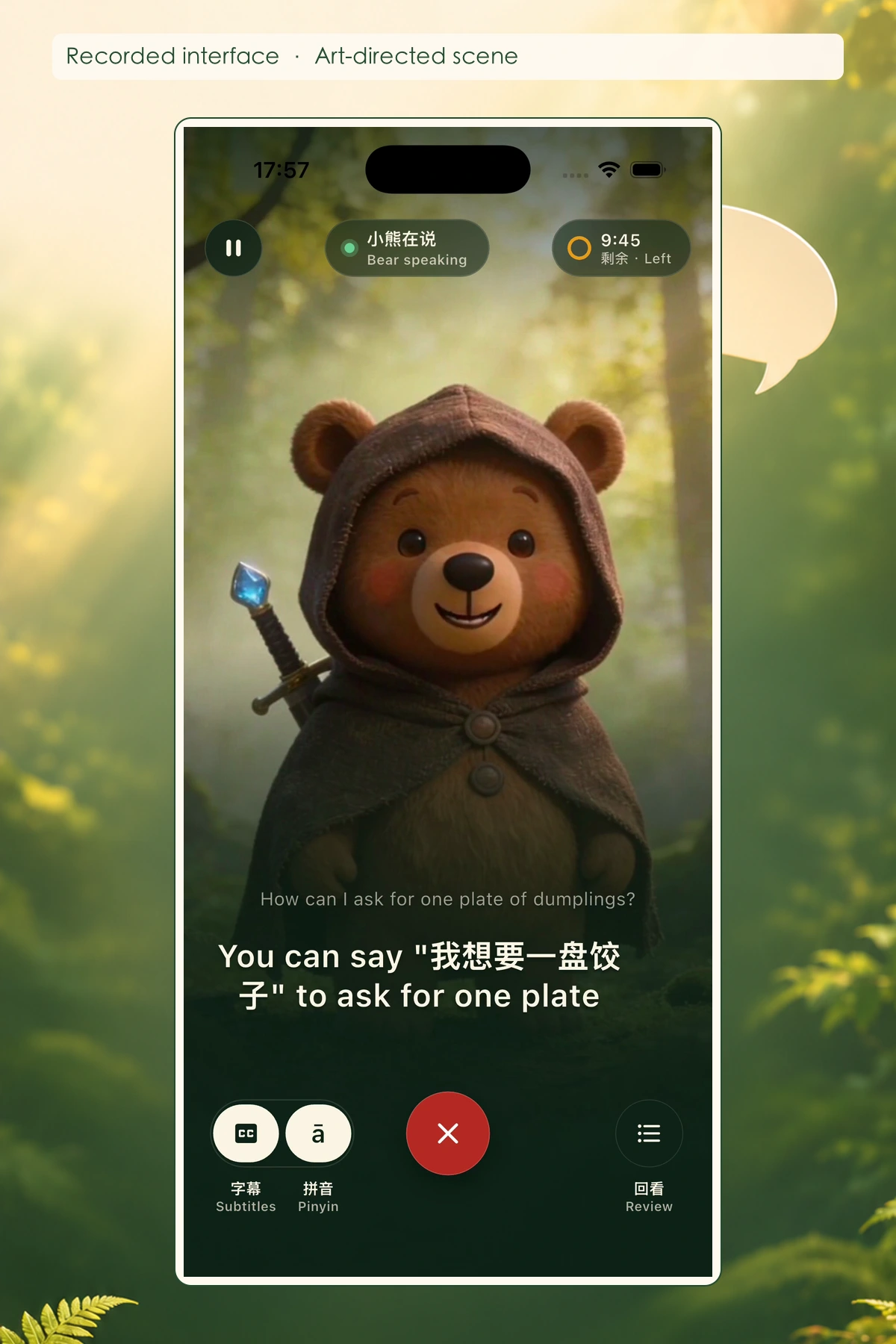
Talk World / 对话世界 identifies this conversation app. Live is an existing code and route name.
The complete recorded example
These are the original lines from one demonstration. Encouragement from the model is a conversational response, not an objective proficiency score.
- Learner
- Bear, how do I say dumpling in Chinese?
- Bear
- Dumpling is 饺子, pronounced jiǎozi.
- Learner
- How can I ask for one plate of dumplings?
- Bear
- You can say "我想要一盘饺子" to ask for one plate of dumplings. Try saying it out loud!
- Learner
- 我想要一盘饺子。
- Bear
- Perfect! The server will likely say, “好的,马上为您准备。” You ordered it just like a local.
- Learner
- 谢谢!They look delicious.
- Bear
- Enjoy your meal! You handled that order perfectly.
Understand the parts of the request
“我想要一盘饺子” brings together an intention, a quantity and the food. The learner first asks for the word, then how to request a plate, and finally attempts the complete expression.
盘 is the measure word used in this sentence. This editorial explanation does not imply that the app includes a separate measure-word course or calibrated assessment.
A modeled server response is not a restaurant promise
The original reply suggests that a server may say “好的,马上为您准备。” That is a model’s illustration of the setting, not a real server’s answer or a guarantee about every restaurant.
An actual order may involve fillings, quantities, availability or different ordering procedures. Continue clarifying according to the situation.
Change one part after understanding the whole
After hearing the full exchange, keep one clear request goal and ask how to order a different food. Check whether its quantity word and phrasing need to change.
This is a way to practice communication, not certification, professional pronunciation scoring or clinical language training. Check current regional availability, eligibility, microphone permissions and time rules before use.
Editorial practice: understand one line, then complete an exchange
The pronunciation and meanings below are editorial additions. The original recorded wording above is unchanged. You can repeat the lines without signing in or submitting a recording.
- Start with 饺子, then repeat the full request 我想要一盘饺子.
- Respond with 谢谢 after the modeled reply; an actual server may respond differently.
- 一 in 一盘 is pronounced yì here. The pinyin is an editorial pronunciation aid.
- 我想要一盘饺子。
I would like a plate of dumplings.
- 好的,马上为您准备。
All right; we will prepare it for you right away.
- 谢谢!
Thank you.
Can you complete the request and thanks without reading the prompt?
Answer key: 我想要一盘饺子。 → 好的,马上为您准备。 → 谢谢!
This is a public practice suggestion; it does not record completion or return a score. The app is released; check eligibility before use.
Sources, editing and corrections
Prepared and maintained by the Lingo Bear product team. Publisher and operator: Beijing Jianren Jianzhi Technology Co., Ltd.
- Demonstration recorded
- Content checked
This example retains all four recorded rounds and eight utterances. The model’s encouragement is original dialogue, not a professional pronunciation or proficiency score.
Examples use approved team demonstration material, with demonstration names and synthetic voices. They do not use private learning records or real-child testimonials.
Recorded inputs, model wording and book text retain their original meaning. Practice prompts, language analysis and reading questions are identified as editorial additions.
Prices and availability are checked as of the stated date. Report a page error using the link below; confirmed errors are corrected in the text, with the review date and a note for substantive changes.
Include the page link, passage and suggested correction. Do not send a child’s name, recordings, private stories or account credentials. Report an error on this page
Questions before you begin
Does “Perfect” mean the app gave a professional score?
No. It is the model’s encouraging wording in the recorded exchange, not a calibrated pronunciation or proficiency score.
Must practice be entirely in Mandarin?
This example starts with English help and then a Mandarin target sentence. Other language combinations depend on current product support and the actual results.